Buildings near university campuses occupy a particular kind of civic position. They are not just residential structures. They are neighbors to institutions that have shaped their surrounding neighborhoods over generations — institutions whose architecture, landscaping, and urban presence define the character of entire districts. A building that ignores this context does not just look out of place. It damages the neighborhood it enters.
It signals that the developer viewed the site as a financial opportunity rather than a civic responsibility. Scholar's Row holds a different view — and builds accordingly.
Campus context as a design brief
Every Scholar's Row project begins with a careful reading of its specific context. What are the dominant materials on the surrounding blocks? What are the typical building heights, setbacks, and proportions? How does the academic institution's own architecture relate to the residential fabric around it? What does the street look and feel like at the pedestrian scale? These questions are not preliminary to the design process.
They are the design process. The answers shape every significant architectural decision — from the choice of cladding material to the rhythm of windows to the way the building addresses the sidewalk. This approach produces buildings that feel like they belong. Not because they imitate their surroundings or retreat into pastiche, but because they have been designed with genuine attention to context — understanding what makes a neighborhood work and contributing to it rather than competing with it.
The case for traditional materials with modern execution
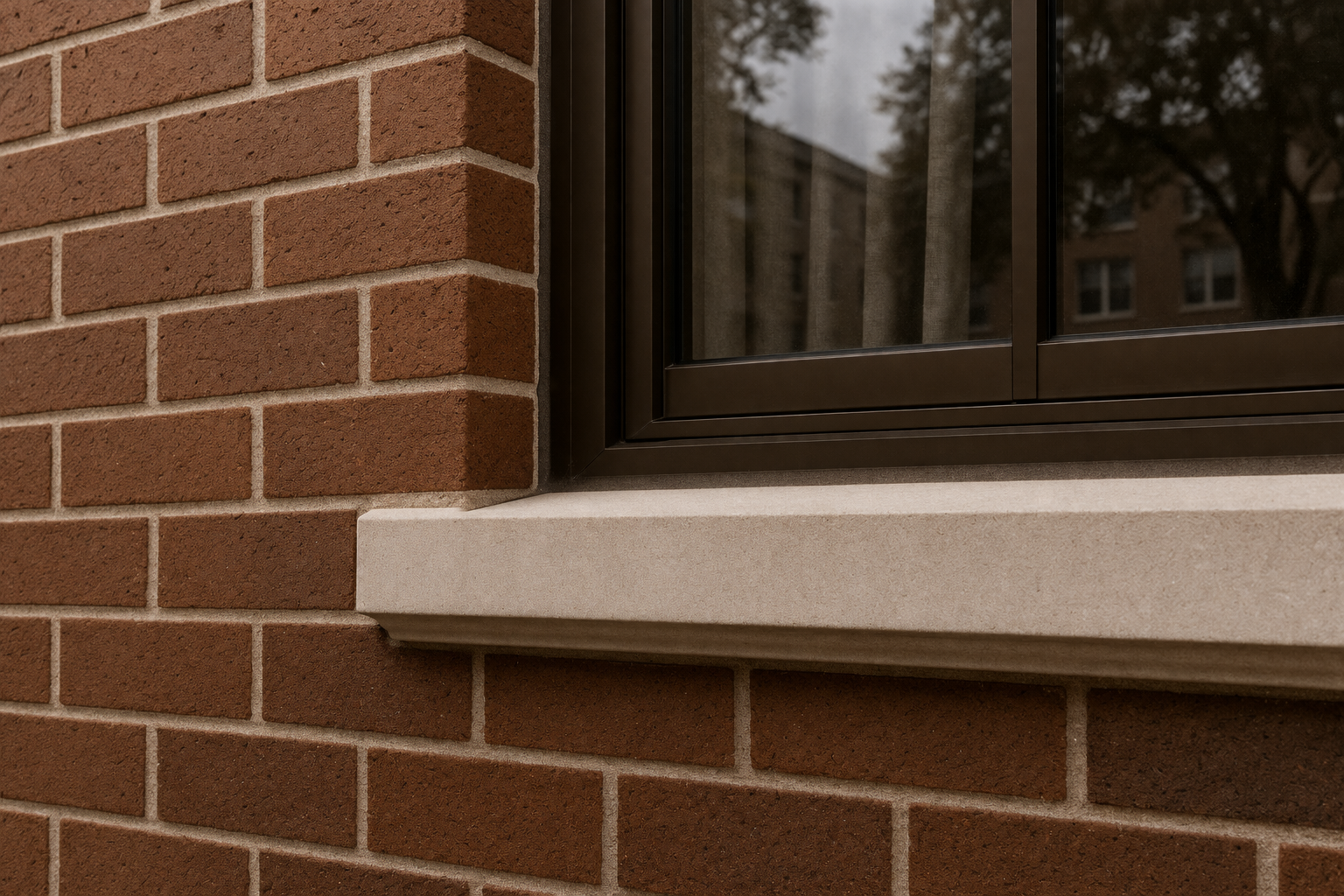
Scholar's Row buildings are typically characterized by warm brick facades, modern aluminum-framed windows, and clean material transitions. This combination is not accidental. Brick is the dominant material language of most established American university districts. It is durable, contextually appropriate, and ages well — developing character over time rather than deteriorating. A brick building that is well-detailed and well-maintained looks better at twenty years than it did at two.
This is exactly the performance profile that a long-term owner-operator should want. Modern window systems — thermally broken aluminum frames, high-performance glazing, considered proportions — bring the building's performance into the present without disrupting its contextual fit. The result is architecture that reads as contemporary but not jarring: a building that a university administrator, a faculty member, or a municipal planning board can look at and understand as a responsible addition to the neighborhood.
Scale, proportion, and the boutique model
Architectural integrity near a university campus is not only a question of materials and style. It is also a question of scale. Scholar's Row's boutique model — typically 10 to 30 units — is not only a financial or operational preference. It is an architectural and urban design preference. A building at this scale can be designed with care. It can sit comfortably on a constrained urban site without dominating it.
It can relate to its neighbors at a human scale. It can be the kind of addition to a neighborhood that the neighborhood can absorb without being transformed by it. This scale also allows for a level of design specificity that larger projects cannot achieve. When a building has 25 units rather than 200, the architect can give serious attention to every facade condition, every material transition, every detail of the entry sequence. The result is a building that rewards close looking — that reveals the care invested in it to anyone who takes the time to notice.
The relationship between design integrity and long-term value
Architecture that fits its context and is executed with care holds its value differently than architecture that does not. A contextually appropriate building in a stable academic district is not competing against new supply every few years. It is part of the neighborhood fabric — something that is difficult to replicate and that residents, university partners, and neighbors have an interest in seeing maintained. This is a different kind of asset than a generic apartment building that could be located anywhere.
Scholar's Row invests in architectural integrity not because it is the right thing to do in an abstract sense — though it is — but because it produces better assets. Buildings that belong to their neighborhoods are buildings that will continue to perform in those neighborhoods for decades. That durability is part of the investment thesis, and it begins with the quality of the design.
.jpg)
More from our team
Explore recent perspectives on housing and university partnerships

Ready to explore further
Connect with our team to discuss opportunities and partnerships.