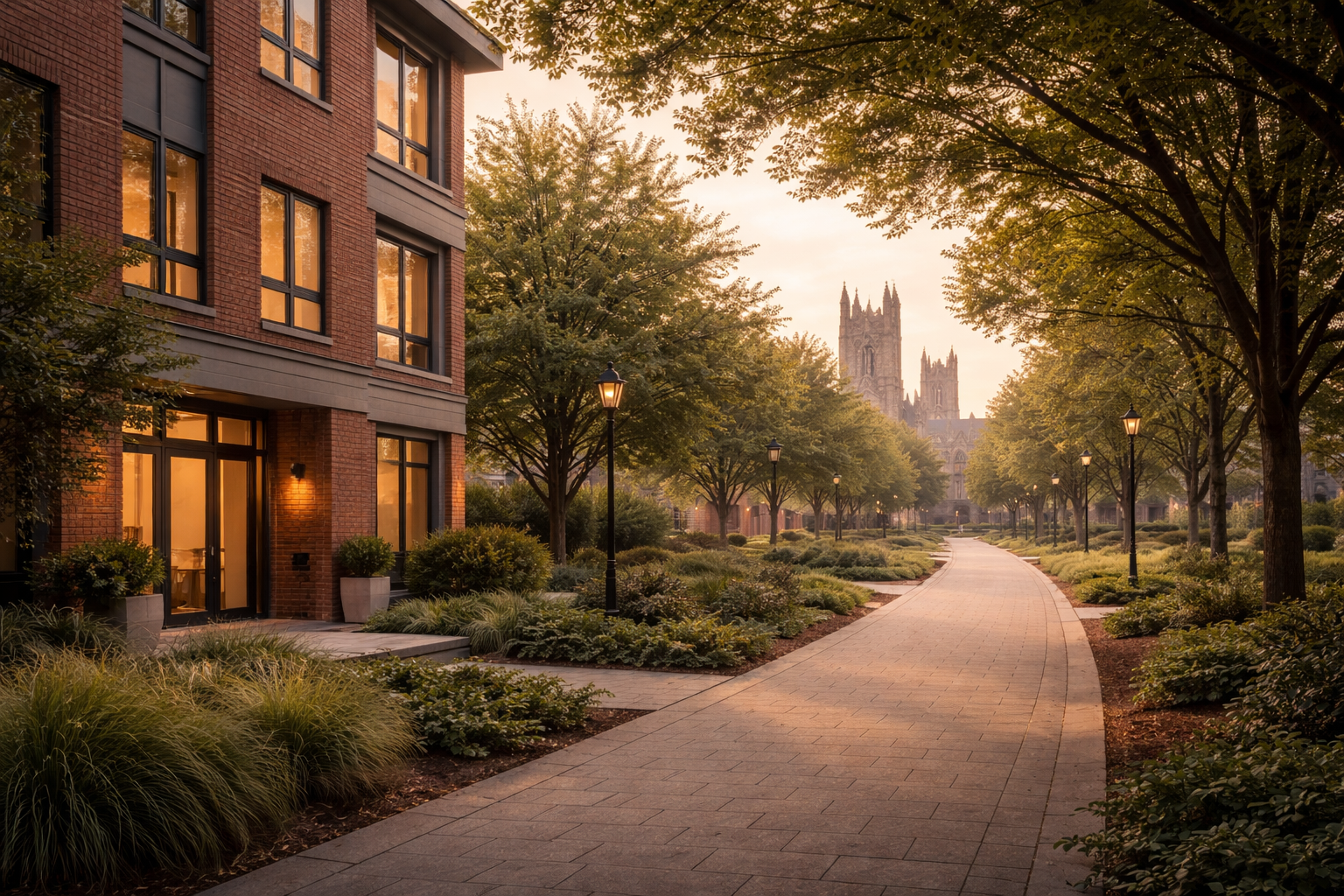
The decision about where to build is not separate from the decision about what to build. For graduate housing, they are the same decision. Scholar's Row begins every project with a simple requirement: true walkability to campus. Not transit-adjacent, not a short drive, not a fifteen-minute bus ride on a good day. Walking distance — the kind that allows a graduate student in medicine or law to move between residence, lab, library, and clinic without a second thought about logistics.
This constraint is intentional and non-negotiable. It shapes everything that follows.
Why location is part of the product
Graduate students and visiting faculty operate under a different set of pressures than typical renters. Their schedules are irregular, their cognitive demands are high, and their time is genuinely scarce. A commute that adds twenty minutes each way is not an inconvenience — it is a meaningful degradation of their working day.
Housing that requires a car, a bus, or a bike to reach campus is housing that competes with academic life rather than supports it. Walkability also shapes the design of a building. Sites in true academic districts — on the streets that connect residence to campus, clinic, and library — tend to be urban, constrained, and contextually specific.
They require a different design approach than a suburban pad site. Buildings in these locations need to fit their surroundings: in scale, in material, in proportion, and in the way they address the street. This is why Scholar's Row develops boutique buildings rather than large complexes.
A 20 to 30 unit building on a walkable academic block belongs there in a way that a 200-unit complex does not. The scale fits the neighborhood. The architecture can be considered. The relationship to the street can be direct and human.
How site selection drives design decisions
Once a site is identified, its constraints become the design brief. The dimensions of the parcel, its orientation to sunlight, its relationship to neighboring buildings, the noise environment of the surrounding block — all of these shape how a building should be organized, how units should be positioned, and where acoustic protection needs to be concentrated.
A site adjacent to a research hospital, for example, may have different noise challenges than one set back from a quiet academic street. A site on a corner in an urban neighborhood may offer more options for natural light than a mid-block infill lot. A building that sits between an undergraduate dormitory and a major arterial road requires a fundamentally different acoustic strategy than one positioned on a residential side street.
Scholar's Row approaches each of these conditions as a design problem to be solved rather than a constraint to be accepted. The goal is not to minimize the site's limitations but to understand them well enough to build something that performs correctly within them.
The relationship between location and long-term value
Well-located academic housing is structurally different from commodity rental housing. Demand is anchored to the institution, not to broader market cycles. Graduate enrollment at major research universities has grown consistently for decades, largely independent of economic conditions, and the pipeline of qualified residents — students, researchers, medical professionals, visiting faculty — renews itself on an annual basis.
This durability is partly a function of supply. The same urban constraints that make walkable academic sites difficult to find also make them difficult to replicate. When a building is well-positioned relative to a major campus, that advantage does not erode. Scholar's Row selects sites not only for their current walkability but for their long-term defensibility.
The question is not just whether this location works today — it is whether it will continue to work in twenty years, as the institution grows, as the surrounding neighborhood evolves, and as the demands of graduate life continue to intensify. Location, in the end, is not a starting condition.
It is a long-term asset.
.jpg)
More from our team
Explore recent perspectives on housing and university partnerships


Ready to explore further
Connect with our team to discuss opportunities and partnerships.