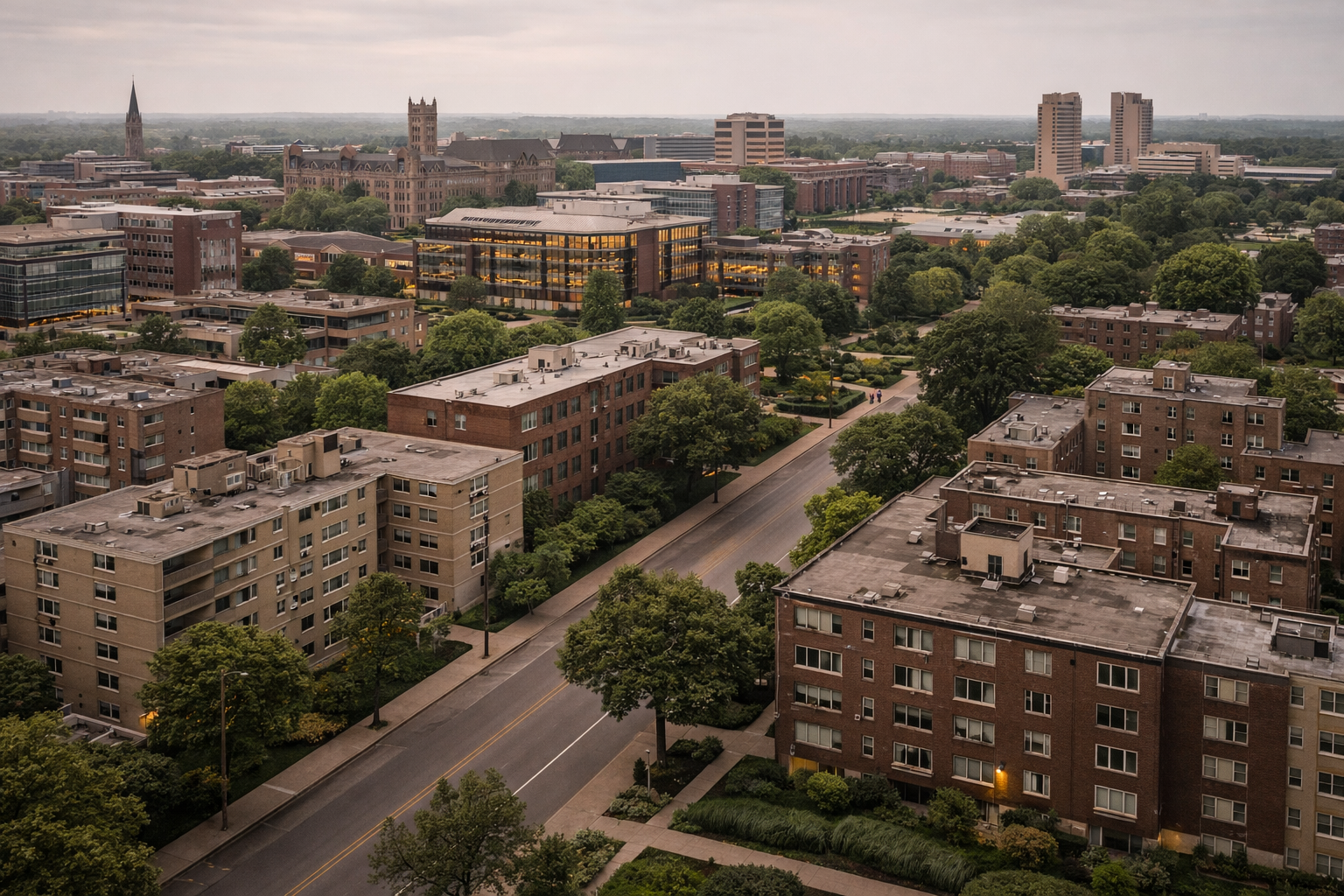
The graduate housing shortage is not a new problem. It is a structural one — and it has been getting worse for a long time. Across the country, graduate enrollment at major research universities has grown steadily for decades. The pipeline of graduate students, doctoral candidates, medical residents, and visiting faculty continues to expand, driven by institutional growth, federal research investment, and increasing demand for advanced professional credentials. The supply of housing designed to serve them has not kept pace.
The nature of the shortage
What makes the graduate housing shortage distinctive is not simply that there are not enough units — though that is true. It is that the units that do exist are largely the wrong units, in the wrong locations, with the wrong performance characteristics.
Much of the housing closest to major campuses was built for a different era of student life. It was designed for undergraduates, not graduate students. It was not engineered for acoustic performance, indoor air quality, or the specific spatial requirements of someone who works from home, studies late, and needs to be able to sleep during the day between hospital rotations.
Graduate students and visiting faculty need something different: a one-bedroom or studio apartment within walking distance of campus, quiet enough to support sustained intellectual work, well-managed enough to remove friction from daily life, and durable enough to serve them for two, three, or four years without requiring constant adjustment. This product barely exists at scale in most university markets.
Why private capital has not solved it
The graduate housing shortage persists in part because it occupies an awkward position in the real estate market. The sites that matter most — walkable, urban, campus-adjacent — are expensive, constrained, and difficult to entitle. The scale of development that makes economic sense for large operators does not fit these sites or this resident population.
Boutique development in constrained academic districts requires a different kind of operator: one with the discipline to work at small scale, the design sensibility to build something contextually appropriate, and the patience to build an institutional relationship with the university over time rather than extract value from a single transaction. Scholar's Row was built for exactly this role.
What addressing the shortage actually requires
Solving the graduate housing shortage — even partially, even in a handful of markets — requires developers who are willing to specialize. Who understand that a 25-unit building on a walkable street near a major medical school is a different product than a 300-unit complex on a highway interchange. Who are willing to invest in acoustic performance and indoor air quality not because they are required to but because they understand who they are building for.
It requires universities that are willing to engage with private partners who are serious about design quality and long-term stewardship — and who understand that the housing environment their graduate students occupy has a direct effect on recruitment, retention, and academic performance.
And it requires capital that is patient enough to understand that the durable demand characteristics of well-located graduate housing represent a long-term structural advantage, not a speculative bet. Scholar's Row is building toward that convergence — one carefully selected project at a time.
.jpg)
More from our team
Explore recent perspectives on housing and university partnerships

Ready to explore further
Connect with our team to discuss opportunities and partnerships.